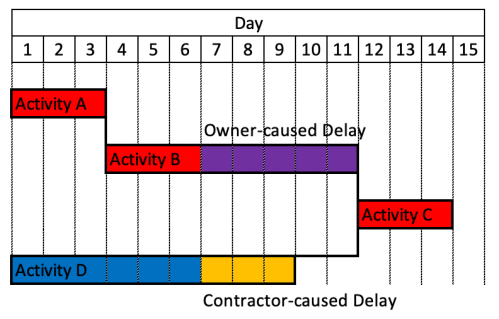
An Collapsed As-Built / As-Built But-For Schedule Delay Analysis (ABBF) is a retrospective CPM schedule delay analysis technique that determines the earliest date that the required project completion activity, or various milestone activities could have been achieved but-for the owner-caused delays that occurred during the project. The amount of owner-caused delay determined from the ABBF Schedule Delay Analysis quantifies the contractor’s entitlement to receive compensable delay damages. Similarly, the analysis could determine the earliest date that the various completion activities could have been achieved but-for the contractor-caused noncompensable delays that occurred during the project.
The ABBF Schedule Delay Analysis is typically more difficult to perform than the Time Impacted Analysis because most CPM software programs regard as-built dates as historical events fixed in time. As a result, most CPM software programs will not permit but-for analysis models to be run on schedule containing actual dates. Consequently, the as-built schedule must be converted to an as-planned format containing “planned” dates that correspond to the as-built schedule but are driven by logic and activity durations. This conversion step is used to create an As-Built Calculation Schedule that can collapse as delays are removed.
The ABBF Schedule Delay Analysis is performed by first removing owner-caused delays from the As-Built Calculation Schedule and recalculating the project completion date. Contractor-caused (noncompensable) and excusable (force majeure, acts of God…) delays are left in the As-Built Calculation Schedule. The As-Built Calculation Schedule with owner-caused delays removed is used to determine the compensable time period between the actual project completion date and the as-built but-for completion date.
Next, contractor-caused delays are removed from the original As-Built Calculation Schedule and the project completion date is recalculated. Owner-caused (compensable) and excusable (force majeure, acts of God…) delays are left in the As-Built Calculation Schedule. The ABBF Schedule Delay Analysis that removes contractor-caused delays is used to determine the time period between the actual completion date and the as-built but-for completion date for assessment of liquidated damages by the owner.
Why we need this method
It is a common misconception in the construction industry that if the contractor is entitled to an extension of time, then it is also automatically entitled to be compensated for the additional time that it has taken to complete the contract. It is usually not.
Advertisements
about:blank
Report this ad
An additive delay analysis, such as the Time Impacted Analysis, by itself does not provide an answer to the issue of compensable delay. If a contractor incurs additional costs that are caused by both owner delay and concurrent contractor delay, then the contractor should only recover compensation to the extent it is able to separately identify the additional costs that were only caused by the owner delay. If it would have incurred the additional costs in any event as a result of concurrent contractor-caused delays, the contractor will not be entitled to recover those additional costs unless provided otherwise in the contract. Therefore, the ABBF Schedule Delay Analysis is often performed to address the issue of compensable delay net of concurrent contractor-caused delay on the as-built schedule, which the Time Impated Analysis do not analyze properly.
Source: As-Built But-For Schedule Delay Analysis – Richard J. Long, P.E. – Long International, Inc.
Data Requirement
We will demonstrate this method by using a simple House project as below.
The House project has an As-Planned schedule like following picture:
Project duration is 40 days.
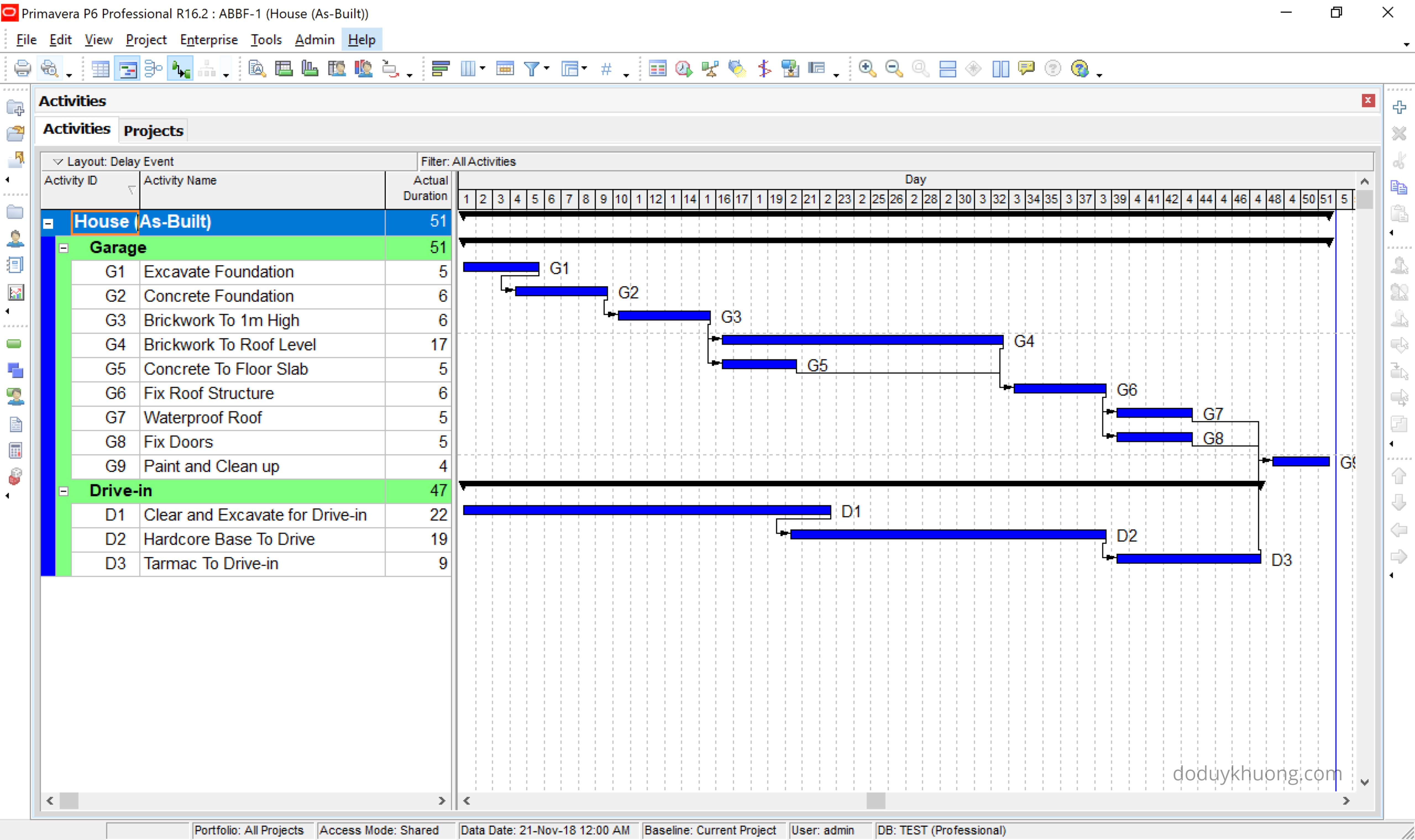
The project finished and As-Built schedule is as below:
Actual project duration is 51 days.
Advertisements
about:blank
Report this ad
This As-Built schedule already included all delay events which is documented in below table:
Source: Construction Delay Analysis Technique – A Review of Application Issues and Improvement Needs – Nuhu Braimah
Type of Delay:
NN (Nonexcusable–Noncompensable): Contractor-caused delay
EC (Excusable Compensable): Owner-caused delay
Create As-Built Calculation Schedule
Create another As-Planned schedule which has Start/Finish date look like As-Built schedule. This schedule is called “As-Built Calculation Schedule”
Separate delay events to a different project so that later we can exclude them.
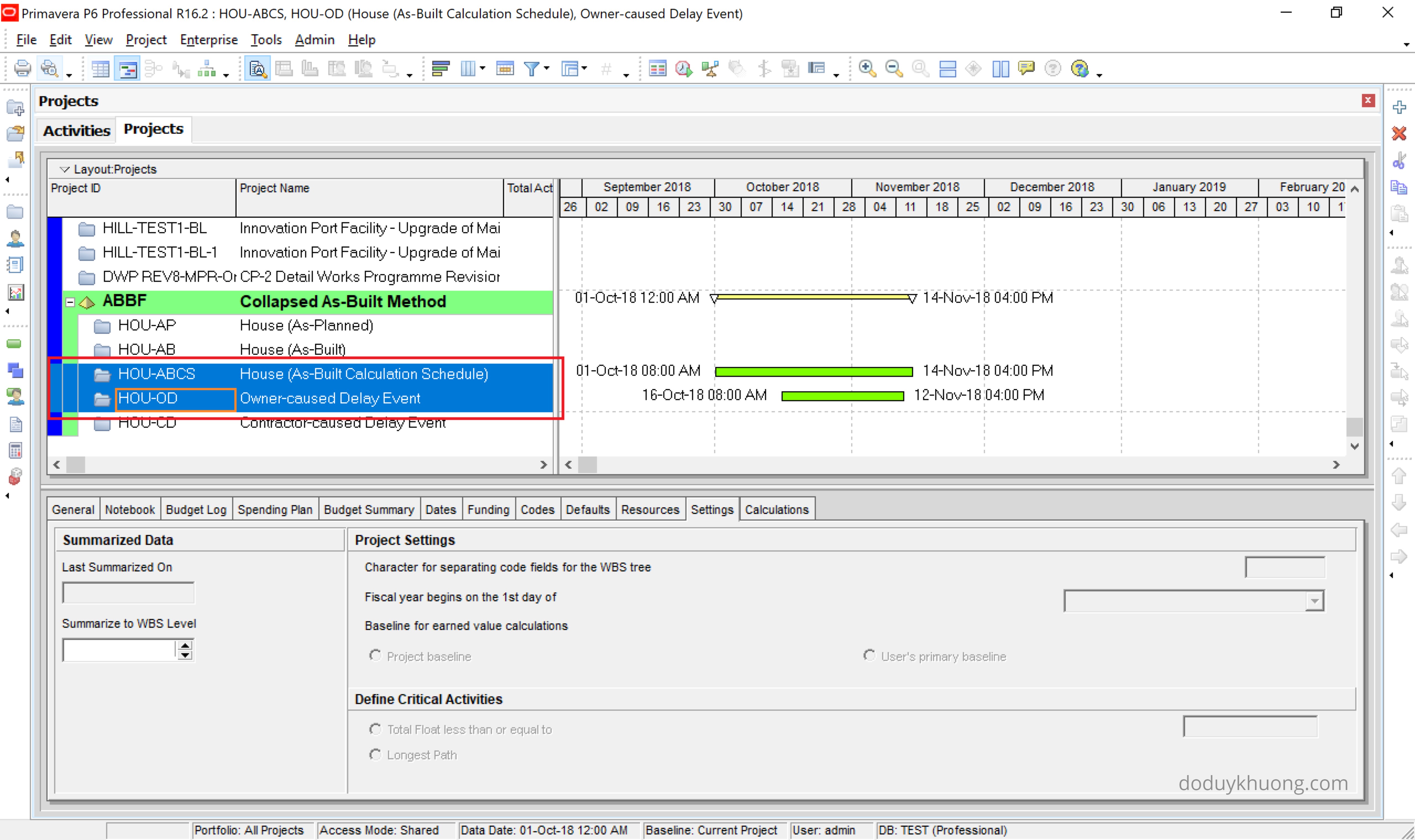
We created 1 project (As-Built Calculation Schedule) and 2 projects (contain Owner-caused delay and Contractor-caused delay):
Opening 3 projects we have this schedule:
Using Activity Code function to put delay event next to activity, we have this view:
We can see that Start/Finish date (of each activity and whole project) and relationship of As-Built Calculation Schedule now look exactly the same with As-Built schedule.
Create Collapsed As-Built report
Contractor’s point of view (As-Built But For Owner):
Under this, all owner-caused delays were subtracted from the As-Built Calculation Schedule.
Advertisements
about:blank
Report this ad
We open 2 projects: “House (As-Built Calculation Schedule)” and “Contractor-caused Delay Event”
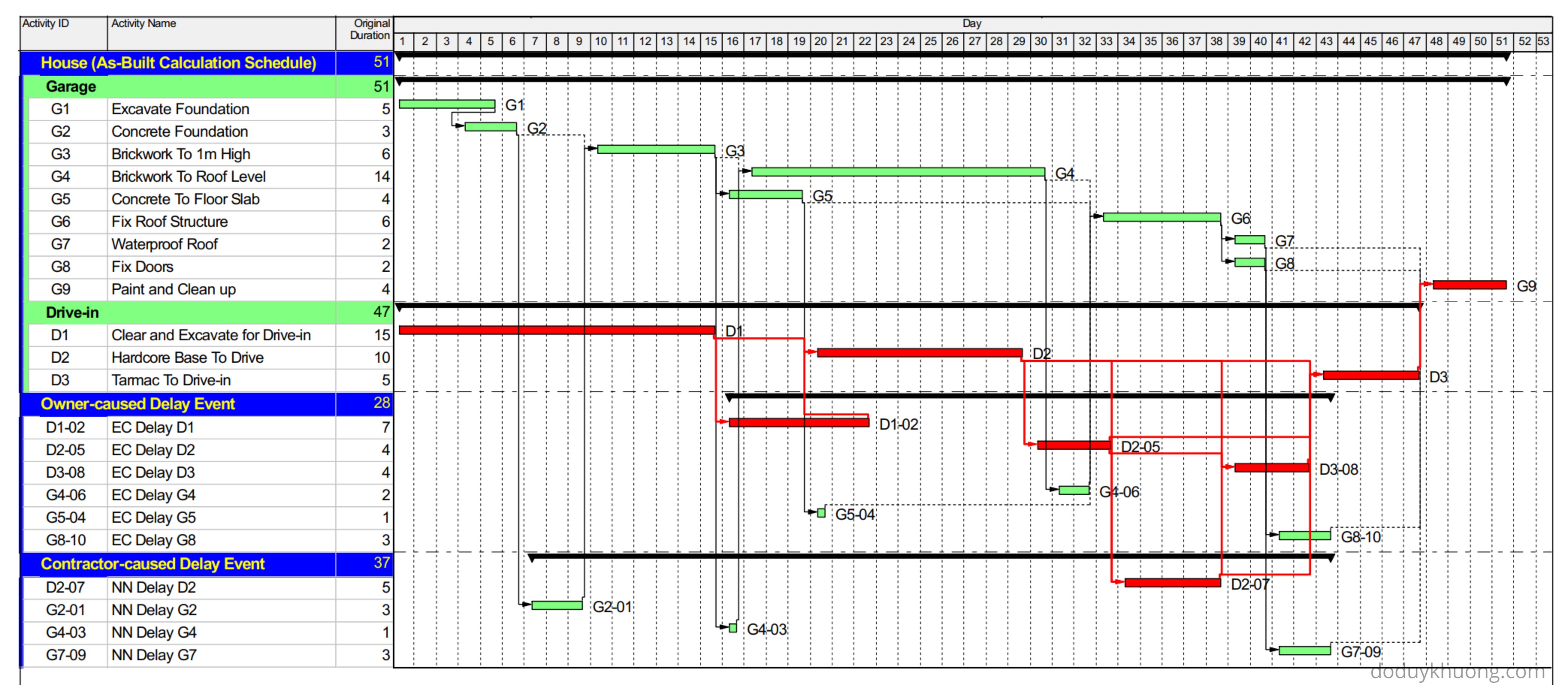
Reschedule then we have this report:
The collapsed as-built schedule has completion date as day 45.
With actual completion date as day 51, the owner is responsible for 6 days (51–45) of the project delay, which could be charged as compensable delay.
With original (baseline) completion date as day 40, the contractor is responsible for 5 days (45–40) of the project delay.
Owner’s point of view (As-Built But For Contractor):
Under this, all contractor-caused delays were subtracted from the As-Built Calculation Schedule.
We open 2 projects: “House (As-Built Calculation Schedule)” and “Owner-caused Delay Event”
Reschedule then we have this report:
The collapsed as-built schedule has completion date as day 46.
With actual completion date as day 51, the contractor is responsible for 5 days (51–46) of the project delay, which could be charged for liquidated damages.
With original (baseline) completion date as day 40, the owner is responsible for 6 days (46–40) of the project delay.
References:
The project data and delay events is taken from “Construction Delay Analysis Technique —A Review of Application Issues and Improvement Needs” – Nuhu Braimah
As-Built But-For Schedule Delay Analysis – Richard J. Long, P.E. – Long International, Inc.
After performing delay analysis work in Primavera P6 or MS Project, we should make a summary graphic report for high-level manager. It would be difficult to get the overview of the analysis with a detail report like the following picture:
A simple bar chart or timeline would be more effective and I would like to show a few samples as follows.
The term “concurrent delay” is commonly used to describe circumstances where owner-caused delays and contractor-caused delays occur at the same time.
In true concurrency, the owner and contractor delay events (the cause of delay) both occur at the same time and the delay caused by the delay events start and finish at the same time. True concurrency is unlikely to occur and this narrow definition is too limited for practical application. Conversely, Keating (Keating on Construction Contracts 10th ed, Sweet & Maxwell, 2016) considers delays as concurrent when:
each delay event, in the absence of any competing event, has caused delay;
each delay event is on the critical path; and
the delays caused by the owner and the contractor overlap.
Typical scenarios of concurrent delay and how to resolve them
In situations of concurrent delay, the Contracts between the parties must first be examined to determine whether they provide an answer to how the allocation of liability for any concurrent delay should be considered without sophisticated analysis.
The contract between the parties may provide no direct guidance as to the treatment of concurrent delay. Then the most common principle applied in the international construction industry which addressed below is utilized.
1. True Concurrency
Advertisements
about:blank
Report this ad
If the owner-caused and contractor-caused delays are concurrent and of equal duration, and if they equally affected the critical path to project completion, the contractor would not be entitled to compensable delay damages and the owner would not be entitled to its actual delay or liquidated damages.
The Contractor is still entitled to a full Extension of Time (5 days).
2. Partial Concurrency
AACE International’s Recommended Practice No. 29R-03 for forensic schedule delay analysis states the following:
“…That is, the contractor is barred from recovering delay damages to the extent that concurrent contractor-caused delays offset owner-caused delays, and the owner is barred from recovery liquidated or actual delay damages to the extent that concurrent owner-caused delays offset contractor- caused delays.”
The Society of Construction Law Delay and Disruption Protocol states the following:
“If a contractor incurs additional costs that are caused by both owner delay and concurrent contractor delay, then the contractor should only recover compensation to the extent it is able to separately identify the additional costs that were only caused by the owner delay. If it would have incurred the additional costs in any event as a result of concurrent contractor- caused delays, the contractor will not be entitled to recover those additional costs unless provided otherwise in the contract.”
In this example, the Contractor’s compensable duration is 2 days. It can not receive 3 days of compensation for its own delay.
The Contractor is still entitled to a full Extension of Time (5 days).
Functional concurrency occurs when the separate network paths, on which the delays reside, concurrently impact the Project Completion date.
AACE International Recommended Practice No. 29R-03 Forensic Schedule Analysis (Section 4.2.D.1, p. 105.) affirms that the functional theory is “closely attuned to delay methodologies that use modeled CPM schedules as their basis and utilize some form of time period analysis. Since these analyses measure delay at the end of time periods [typically the status updates] it makes sense to measure concurrency under this methodology at the same points, rather than trying to develop a separate concurrency analysis. Accordingly, the functional application of concurrent delay theory does not necessarily require the delay events to occur at the same time. In addition, the functional theory allows that CPM schedules, even if properly maintained, are not perfect, and near critical delays may in fact be concurrent.”
In this example, there would be no compensable delay for the Contractor and the Owner.
The Contractor is still entitled to a full Extension of Time (5 days).
Summary Table of Concurrent Delay Scenarios and Net Effect
The various permutations of concurrent delay are summarized by AACE International in Table below (Recommended Practice No. 29R-03 Figure 12- Net Effect Matrix-Concurrent Delay, p. 100.):
Advertisements
about:blank
Report this ad
What is Pacing Delay?
Pacing delay occurs when the delay in one activity occurs, and a conscious and contemporaneous decision is made by the contractor to pace progress in a second and independent activity. Thus, the contractor deliberately slowed down its work in an effort to “keep pace with the owner’s delay”. The thinking typically expressed by contractors is “Why should I hurry up and wait?” because the owner-caused delay was driving the project completion.
It is common for construction contracts to not address or define concurrent delays let alone “pacing.” Most construction contracts contain specific language such as, “time is of the essence” or “a contractor shall diligently perform the work” which requires a contractor to expedite the completion of the work. Consequently, most construction contracts do not inherently sanction a contractor to “pace” its work when delayed by an owner-caused impact to the critical path.
However, nearly all construction contracts include an implied warranty that requires the contracting parties not to delay, hinder, or interfere with the performance of the other party. A contractor is allowed to enjoy a least cost performance based on implied warranty. When an owner delays the critical path, the contractor is permitted to mitigate costs to the benefit of the contractor thereby providing a basis for “pacing.”
Pacing is typically presented in two scenarios.
1. Direct Pacing – This situation occurs when the duration of a successor schedule activity is extended due to a delay in a predecessor activity on which the progress of the successor activity is directly dependent. An example would be that the duration of wire pulling is delayed because conduit installation is taking longer than anticipated due to the lack of conduit materials on the site. This is pacing delay, not concurrent delay because the cause of one delay is the result of the other delay.
2. Indirect Pacing – In this situation, the paced activity has no dependency on the other activity. For example, a contractor deliberately slows down piping installation in one area of the project due to an owner-caused delay in another area of the project. The owner-caused delay creates float while the contactor’s decision to slow down piping installation consumes this float.
In its evaluation of potential concurrent delay vs. a pacing delay, the following generally accepted international construction industry guidelines apply, in order of importance, as follows:
1. A predecessor dependent parent delay must precede a pacing delay; 2. The contractor needs to demonstrate that it could resume progress at an un-paced rate; and 3. The contractor needs to provide evidence that a conscious and deliberate decision was made at the time to pace the work as a result of the other delay.
If no documentation is made available to justify a pacing delay, then consistent with the AACE International recommended practice, concurrent delays by the contractor should not be regarded as pacing delays, and instead are delays for which the contractor is responsible.
References:
Analysis of Concurrent Delay on Construction Claims – Richard J. Long
A construction claim is the assertion of a right demanding either additional time or/and payment due to the result of an action. It is possible to meet construction claims in all construction projects.
Why do Construction Claims occur?
Clients, contractors, and subcontractors of this environment try to reach their own goals and expectations in order to increase their benefits. Conflicts may arise as a result of this diversified goals and expectations of parties.
They can be originated by several other reasons such as inadequate project planning, changes in scope, change orders, errors and omissions.
What is the consequence?
If the conflicts are not managed successfully, disputes which affect the successful completion of the construction project may arise.
1.2. Claim Management
Claim management is an unavoidable process in construction project management which requires effective management practices during the entire life cycle of a project.
A typical claim management process basically has 4 phases as follows:
Claim Prevention: The claim prevention process is activated at the Pre-tender and Contract Formulation phases of a project. Contract documents project plans and scope of work should include all requirements related to the project because after the award of contract the opportunity to prevent claim comes to an end.
Claim Mitigation: Construction activities are generally performed in highly sensitive and outdoor environments. It is better to minimize the possibilities of occurring claim all through the progression of the contract. A well-defined scope, responsibilities and risks will help to decrease the possibility of occurrence of claims. Also, risk management plans play important roles in the phase of claim mitigation.
Pursuing Claims (Claim Identification and Quantification): Claim identification can be done by analyzing both the scope of work and the provisions of the contract. Inputs of the claim identification process are the scope of work, contract terms, definition of extra work and definition of extra time requested. Once an activity is identified as a claim, it will be quantified in terms of an additional payment or a time extension to the contract completion or other milestone dates. In this phase, a schedule and critical path analysis should be made in order to calculate the delay of the project. In addition to that, additional direct and indirect costs originated from the claimed activity should be calculated.
Claim Resolution: Claim resolution is a step by step process to resolve the claim issues. If an agreement between the parties is reached, then the claim is resolved and becomes a change order. If the agreement is not reached, depending on the resolution terms of the contract the claim may proceed to negotiation, mediation, arbitration, and litigation before it is completely resolved.
2. Characters of a Highly Impacted Project
A lot of projects are out of control and headed for claims and disputes. The characters of these projects are described as follows:
The contractor bids on incomplete design documents;
The contract is awarded to the lowest bid contractor but not necessarily the most qualified;
The owner/engineer issues a large number of design changes;
The owner is inadequately staffed to process the multitude of change orders and respond in a timely manner to the numerous RFI from the contractor;
The contractor fails to prepare an adequate as-planned or baseline schedule to identify the planned sequence and duration of work;
The contractor fails to maintain an accurate and updated progress schedule including identification of changes and cause of delays;
The contractor requests a time extension that is denied because of inadequate support to recognize excusable delays;
The project is completed late, the owner has paid a significantly higher price for many changes, the contractor now has a big delay and impact claim, and the owner withholds payments to cover its liquidated damages.
3. Effect on the Project
Large value claims may destroy the viability of a project or make construction more difficult by adding to the disappointment between the owner and contractor. If a sizable claim is found to be valid, an owner faces serious problems. New financing may be required, later occupancy may be necessary, income from operation of the facility or rent from commercial property may be delayed or lost, and staffs may have to be funded longer than planned to administer the project.
Advertisements
about:blank
Report this ad
Most owners include contingency funds in their project budgets to cover the cost of claims. However, the contingency funds are usually limited and seldom are large enough to handle claims. If a project experiences unfunded cost increases, emergency actions may be required, such as a temporary halt to construction, requesting special appropriations, financing by additional borrowing.
Almost any of these solutions create serious problems for the owner, as well as the contractor, because lost time costs money. Nonreceipt of payments resulting from incurred costs not envisioned in the contract price may result in the contractor’s financial capability becoming dangerously unstable, and his being unable to pay his subcontractors or suppliers. Subcontractors, in turn, may default and the project may collapse due to a lack of resources and money.
4. Situations Causing High-cost Claims
From Contractor:
Inadequate site investigation before bidding: Too often, the contractor will bid work without performing an adequate site investigation into areas such as availability of qualified labor, labor productivity, weather patterns, underground conditions, and other competing projects in the area that would compete for the available labor. As a result of not doing their homework adequately, contractors may then take every opportunity to prepare change order requests or file claims to make up for their bid errors.
Bidding below costs and over optimism: this practice would be considered a deliberate underbid, presumably justified to break into a new geographic market or new line of work. After the excitement of winning the job disappears and the reality of losing big money on the project occurs, contractors may be persuaded to seek every opportunity to submit requests for change orders or file claims.
Slow mobilization: Many contractors do not perform sufficient planning in advance to effectively mobilize for the project. After contract award, the owner informs the contractor that the site is available and ready for mobilization to begin. In a design-build or EPC contract, the start of construction is often optimistically planned to occur earlier than when the approved for construction drawings are actually completed, and equipment and materials are procured and delivered. Also, contractors may not move on to a site in an efficient or timely manner because of insufficient planning regarding the equipment and labor needs that are required.
Poor planning and use of wrong equipment: the means and methods contemplated by the contractor’s estimators to achieve the productivities anticipated by their bids are often not implemented in the field because inadequate planning is performed prior to mobilizing to the site. When lower than anticipated productivities are experienced, contractors will be on extra alert to identify claim opportunities.
Inadequate cost and schedule control systems: these problems are associated with imperfect management planning and control. Possible explanations for why estimated costs for project activities are so inaccurate when compared to actual costs, and why planned schedules experience significant delay, include poor definition of work activities and improper control of schedules.
Performing defective work: Owners may need to withhold progress payments from contractors that have performed defective work. The delay to the project completion caused by the time required to correct these defects may also justify the owner’s liquidated damages claims.
From Owner:
Inadequate and ambiguous scope definition in the bid documents: a project’s scope must be defined in enough detail for comprehensive scheduling, estimating, and resource allocation to be reasonably accomplished. Whenever the owner is unwilling to make a concerted effort to define the construction project in the early stages, problems will undoubtedly occur throughout the entire project life cycle.
Inadequate time provided for bid preparation: Owners are always under economic pressures to start and complete a new project or a modification to an existing facility. As a result of these pressures, owners may rapidly prepare incomplete bid packages and then request fixed price or unit price bids by a date that does not provide the contractor with an adequate time period to investigate the site conditions, thoroughly read and understand the owner’s specifications, verify the accuracy of the owner’s quantities, secure quotations for equipment and materials, prepare an adequate project schedule, and estimate its costs for performing the work. When this occurs, the contractor can either choose to add significant contingencies to its estimate to cover the risks and hope that its bid is still within the owner’s budget, or bid competitively in spite of the risks and hope that if it wins the bid, it can recover any unanticipated costs through change orders and/or claims.
Competitive bidding: competitive bidding is the procurement practice in which the contractor, who leaves the most money out of his estimate (usually as contingencies), gets the job. The lowest bidder is also the one faced with the highest danger of loss if contingencies, i.e., risks, are encountered. They will search ways to cut losses by seeking additional funds through changes. While competitive bidding is often a sound procurement practice, the owner must recognize that a bid that is significantly below the other bidders is a claim waiting to happen.
Major changes in the plans and specifications during construction: the owner is ultimately responsible for defining the scope of a project during the conceptual phase of the project; the scope will probably change quite frequently. However, changes that occur during the construction phase or even detailed design phase inevitably make life difficult for the construction contractor. Scope changes result from a number of situations, such as owner preferences, design reviews, constructability issues, safety requirements, hazardous operations reviews, and operations and maintenance concerns.
Unrealistic schedules and underestimated costs: Whenever time schedules and/or project costs are based on optimistic predictions of labor productivity, availability of skilled labor, good weather, quantities based on an incomplete design, etc., the project will be burdened with missed milestone dates, cost overruns, and even low morale among project personnel. Sufficient time must be allocated in the planning stage of a project to accurately estimate time and cost requirements.
Owner-furnished materials: owners typically want to procure and furnish their own equipment for unique projects, such as power plants, chemical plants and refineries, because of favorable purchasing agreements with vendors or the special needs associated with such projects. Most owners fail to understand that contractors have specific materials management plans for the project – a plan for when that material will be installed and where it’s going to be stored once it arrives at the site. Most owners have the mistaken belief that whenever owner-supplied material arrives on the site, the contractor can efficiently store or install the materials. The sequence of delivery of bulk material items such as structural steel, large bore piping, and piping supports is extremely important to the contractor’s efficiency. Owners and contractors must thoroughly coordinate and schedule the delivery of these items. Contractors usually have installation schedules that they plan to follow, and this type of misunderstanding leads to significant material management problems.
Failure to give adequate and timely access to the work site: when an owner does not provide the contractor with adequate access to the work site to complete its work in the timeframe and in unobstructed conditions that were anticipated in its bid, the contractor may file a delay and loss of productivity claim for the increased costs resulting from the access problems.
Delayed approval of submissions, shop drawings or materials: these types of delays can often affect activities on the critical path of the project schedule and cause delay claims. The contract should state the turnaround time that is available to the owner to perform these tasks. In addition, the contractor should always state in its transmittals the date when it needs a response.
Unclear definition of Mechanical Completion: owners typically designate the Mechanical Completion Date as the key completion milestone in the contract. When these dates have occurred, the owner can begin to start-up the facility. Also, this date is usually the date from which liquidated damages are measured. Final Completion is the last milestone before the contractor can completely demobilize. Often, the contractor is merely completing punch list work or certain miscellaneous work that was not necessary for Mechanical Completion. Disputes often occur at the end of the project if the definition of Mechanical Completion is unclear. The contractor knows what it has to do for Final Completion, but each owner’s requirement for Mechanical Completion may be different. For example, are as-built drawings and operating manuals required for Mechanical Completion? If the owner requires these items before it will agree to the contractor’s declaration of Mechanical Completion, but the contractor was planning to submit these after it declared Mechanical Completion, a dispute may occur over liquidated damages.
5. Reasons for Forensic Schedule Analysis
Forensic schedule analysis may include a prospective or forward-looking method which uses the contemporaneous schedules to forecast the impact from a current or future event. It may also include a retrospective or backward-looking method which uses the as-built schedule. The reasons for performing a forensic schedule analysis can be numerous and often concern the following issues:
Relief from liquidated damages;
Justification for a time extension;
Proof of delay mitigation;
Change Order impact to the critical path;
Proof of concurrent delay versus “pacing”;
Demonstration of schedule acceleration (i.e., Time Impact Analysis results compared to as-built schedule); and
Recovery of compensable delay.
6. Claim Entitlement Identification
Entitlement is the legal basis of the claim. It may be derived from the language of the contract (for example, the Changes Clause). A thorough understanding of construction contract entitlement is a mandatory prerequisite to the identification of issues on a project that give rise to a contractor’s recovery of increased time and cost of performance. This understanding is also necessary for the analysis and preparation of a claim.
A few typical claim entitlements are listed below:
Delays: problems beyond the control and without the fault or negligence of the contractor that prevent the contractor from proceeding with any part of the work.
Disruption: any change in the method of performance or planned work sequence, contemplated by the contractor at the time the job was bid, that prevents the contractor from actually performing its work in that manner.
Directed Change: the owner enjoys the right to make any change that generally falls within the scope of the contract.
Acts of God/Adverse Weather: typically good for a time extension only if the conditions vary substantially from the norm.
Differing Site Conditions: two types: (1) subsurface or hidden physical conditions at the site differing materially from those indicated in the contract; and (2) unknown conditions at the site of an unusual nature.
Acceleration: performance of the contract work in a time period shorter than that originally contemplated by the contract or performing on time when the contractor is entitled to a time extension for performance.
Defective and Deficient Contract Documents: if the contractor is bound to build according to plans and specifications prepared by the owner, the contractor will not be responsible for the consequences of defects in the plans and specifications.
Owner-furnished Items: the owner’s failure to furnish items in accordance with the contract.
Variation in Quantities: the importance to the contractor is whether its unit prices are sufficient to cover its overhead and other costs if the number of units significantly changes from the owner’s estimated quantities used to prepare the contractor’s bid.
Strikes: typically good only for a time extension.
Suspension: the owner’s directive that work be stopped on a part or the whole of the contract.
Termination: two types: (1) termination for convenience resulting from factors outside the contract; and (2) termination for default when a contractor’s performance is not acceptable.
On a heavily disrupted project. one or a combination of several of the above entitlements may provide to the contractor the contractual basis for compensation for the increased cost of the work or extended duration of performance.
7. Establishing The Cause-Effect Link
A contractor’s claim request must clearly identify what actions or inactions by the owner caused the compensable liability and which of the entitlements bear a direct relationship to the financial loss or schedule impact. This establishes the important cause-effect link that is necessary to support a construction claim, as shown in the figure below.
If the contractor does not comply with the stipulated requirements in the contract, a contractor’s claim may be rendered invalid and rejected due to lack of contract compliance. All contractor claims must be supported by contemporaneous project records and documentation. More specifically, the crucial element of proof needed for delay claims should be based on the contemporaneous project schedules used to execute the work.
8. Assessment of Schedule Quality
The underlying foundation for developing a supportable forensic schedule analysis depends on the quality and reasonableness of the project schedules. Checking the integrity of project schedule for obvious deficiencies is vital to ensure that the schedule is accurate and reasonable. If significant deficiencies exist, then the schedule used to measure, allocate, and assign critical path slippage could be flawed, and any resulting conclusions regarding the schedule analysis could be rendered unreliable. Some vital schedule issues to evaluate include the following:
Determine if the schedule complies with the contract documents;
Ensure that the original contract scope and approved change orders are accurately reflected in the schedule;
Check schedule integrity; and
Compare schedule updates to the baseline schedule to identify significant changes.
8.1. Schedule Complies with Contract Documents
An essential starting point is a thorough review and understanding of the contract documents. It is important to fully understand what documents and drawings are included and how they work together to define the scope of work. The various terms and conditions that define the contract administration procedures, notice requirements, responsibilities, and other contractual duties should be considered.
Advertisements
about:blank
Report this ad
More specifically, the contract documents will likely define, limit, or at least influence the direction of a schedule delay analyst and the selection of the appropriate schedule analysis method.
Other contract clauses and requirements that need consideration regarding schedule delay are summarised as follows:
Liquidated Damages
Time Extension
Changes
Mechanical Completion / Substantial Completion
Weather
Timely Notice
No Damages for Delay
Inspection of Site Conditions
Differing Site Conditions
8.2. Original Contract Scope and Approved Changed Order
An important quality check is to ensure that the complete original scope is represented in the project schedule. On large and complex projects, it is not unusual to find some of the original contract scope to be missing and accidentally excluded from the baseline schedule. This is especially the case when a rolling wave schedule development technique is utilized by the contractor. Therefore, it is important to verify to the extent possible that all required contract scope is represented in the baseline schedule. This is done by going through a verification process of the contract documents and other available project information to determine that the schedule accurately reflects the contractual Scope of Work. Areas for review may include the following:
Engineering, including owner approvals of drawings and specifications;
Procurement, including equipment and material delivery durations and customs clearance activities;
Construction, including the necessary detail to ascertain if all work is included and the critical path is realistic;
Pre-Commissioning activities;
Start-Up and Commissioning activities; and
Quality assurance and quality control activities.
Omission of a required portion of the original work scope within the project schedule could produce a project schedule with an overly optimistic duration for the work because the full scope is not reflected in the schedule. As a result, forecasted early and late dates, float values, completion dates, and the calculated critical path may be unreliable.
In addition, if approved change order work is required to be incorporated into the project schedules, existing activity durations may need to be adjusted or fragnet activities may also need to be added to represent approved change order work in the schedule.
8.3. Schedule Integrity
Because the project schedule is a key management tool for measuring project progress over time, the project schedule should accurately reflect the impacts on specific works, milestones, and completion date. However, it is not unusual for the project schedule to be deficient because activity logic is missing, contractual milestones are artificially constrained, and actual dates are incorrect.
If a multitude of errors and deficiencies in the underlying schedule data exist, then the legitimacy of the schedule analysis may be invalid. Moreover, problems associated with the accuracy of project schedules may mask the true driving impacts that caused schedule delays. Therefore, the basis for claims may be in question. It is important to evaluate the quality and reasonableness of project schedules and identify potential areas of deficiencies that affect schedule accuracy. Common items that can negatively affect the quality of a schedule include the following:
Excessive number of open-end activities;
Overly long activity durations;
Activities with excessively high float values;
Conflicting as-built dates;
Overuse of negative lags;
Excessively long positive lags;
Excessively long negative lags;
Overuse of constraints; and
Activities with incorrect status.
Without fixing these problems, the allocation of delay responsibility may be entirely wrong.
Advertisements
about:blank
Report this ad
In the following paragraphs, some of these deficiencies are examined.
Excessive number of open-end activities:
Open-end activities are defined as activities that have no predecessor, no successor, or both. In theory, all activities should have at least one predecessor and one successor except for: (1) the project start activity (no predecessor activity); and (2) project completion activity (no successor activity).
At a minimum, good scheduling practice should have a very small number or no activities with open-ends. A large number of open-end activities will create erroneous float within the schedule (in Primavera P6, the project start or finish date will be used to calculate the total float of open-end activities). Correcting open-end activities will change float values that may affect the critical activities.
Activities with excessively high float values:
Float is defined as the amount of available time that the start or finish of an activity can be delayed without impacting a project’s overall finish date.
Schedule paths with high float values typically arise due to artificially constrained activities or other very long parallel critical paths. High float values can also result from a large number of activities with open-ends, which is a major issue.
Schedules with a large number of high float activities should be examined and corrected for open-ends or missing logic links that would better optimise the planned dates of activities with high float values.
Inconsistent Use of Schedule Calculation Modes:
Retained logic is often the default calculation mode that contractors typically use for calculation of the schedule. Another type of scheduling calculation mode is progress override. Progress override is typically used to accelerate a schedule which allows out-of-sequence work activities to progress without delay and not wait until its logical predecessor is complete.
In many cases, contractors will use progress override as a way to update a schedule without having to spend the time correcting out-of-sequence work activities. If no reasonable explanation by the contractor is provided, then the inconsistent switching of schedule calculation modes between updates is a deficiency.
A consistent use of schedule calculation mode as represented by the baseline schedule should be used for the schedule updates.
Overuse of Constraints:
Constraints are defined as restrictions on either the start or finish of an activity.
A large number of constraints should be avoided. Constraints artificially lock down a schedule and prevent a schedule to naturally “flow” during a forward and backward pass calculation to determine activity float values and the critical path of the project.
The use of a constraint that affect or alter the critical path should be avoided.
Constraints are also too often used as a shortcut tactic by schedulers when they do not have enough time to properly update the schedule or account for out-of-sequence activities.
8.4. Compare Schedules To Identify Significant Changes
Popular delay analysis methods often employ some form of windows analysis approach, or schedule just before the delay event occur (e.g. TIA). These methods require the accuracy of contemporaneous schedule updates. Therefore, it is important to compare the schedule updates to the baseline, and between the schedule updates to identify changes made. Important schedule comparison checks include the following:
Added and Deleted Activities;
Activity Duration Changes;
Changes to Activity Scope/Names;
Changes to the Critical Paths;
Changes to the Schedule Logic; and
Added Constraints.
The bottom line is that significant schedule changes must be supported by reasonable explanations. If no reasonable explanations are provided, the schedules used to support a delay claim may be at risk.
In Primavera P6, there are two important values: Total Float and Free Float.
So what are the differences between them?
Total Float: is the amount of time an activity can be delayed without delaying the Project Finish Date.
Free Float: is the amount of time an activity can be delayed without delaying its Successor Activity Finish Date.
Let’s look at the following example:
The Total Float value of Activity A, B, C, D, E, I is 0 day. Meaning that if they were delayed, the Project Finish Date would have been delayed.
The Total Float value of Activity F, G, H is 5 days. Meaning that they could be delayed of 5 days without making the Project Finish Date delayed.
The Free Float value of Activity A is 0 day. Meaning that if it were delayed, the Successor Activity Finish Date (Activity B, F) would have been delayed.
The Free Float value of Activity H is 5 days. Meaning that it could be delayed of 5 days without making the Successor Activity Finish Date (Activity I) delayed.
There are a few tips, addressing the relationship between Total Float and Free Float, as follows:
If Total Float value of an activity is zero, definitely the Free Float value of it is zero. Meaning that the activity is critical to Project Finish Date and to its successor.
If Free Float value of an activity is 0, it’s not certain that the Total Float value of it is 0. Meaning that the activity is critical to its successor, but it may not be critical to Project Finish Date.
The Construction Contracts often state that no adjustment to the critical milestones dates or the scheduled completion dates would be made unless the delay affects a critical path activity.
This concept is consistent with industry practice, as stated in the SCL Delay and Disruption Protocol 2nd Edition, page 6: “Unless there is express provision to the contrary in the contract, where there is remaining total float in the programme at the time of an Employer Risk Event, an EOT [Extension of Time] should only be granted to the extent that the Employer Delay is predicted to reduce to below zero the total float on the critical path affected by the Employer Delay to Completion (i.e. if the Employer Delay is predicted to extend the critical path to completion).”
AACE (International Recommended Practice No. 29R-03 Forensic Schedule Analysis, April 25, 2011, Section 1.5, B.6 Delay Must Affect the Critical Path, page 18) addresses this requirement: “In order for a claimant to be entitled to an extension of contract time for a delay event (and further to be considered compensable), the delay must affect the critical path. This is because before a party is entitled to time-related compensation for damages it must show that it was actually damaged. Because conventionally a contractor’s delay damages are a function of the overall duration of the project, there must be an increase in the duration of the project.”
So, if the effect of adding any delays to the schedule is that float is consumed, but no actual delay to the completion of the project results from adding the delays, then the Contractor has no time extension entitlement.
Delay Analysis Methods
Delay analysis can be performed by a few methods.
The Society of Construction Law (SCL) Protocol 2nd Edition (Guidance Part B, paragraph no. 11) lists six common methods described in the table below.
Delay Analysis methods according to SCL Delay & Disruption Protocol
AACE International’s Recommended Practice No.29R-03 for Forensic Schedule Analysis (RP 29R-03) lists nine different methods described in the table below.
Delay Analysis methods according to AACE International’s Recommended Practice No.29R-03
Concepts of Typical Delay Analysis Methods
1. Time Slice Windows Analysis
What is Time Slice Windows Analysis:
Time Slice Windows Analysis is an observational, windows-based methodology that focuses on comparing as-planned, updated and as-built project schedules to identify and quantify delays to the critical path of the project.
The Purpose of the Analysis:
This methodology is a retrospective analysis that uses the project schedule updates to quantify the slippage to the critical path during a select period of time;
Once all critical path activity delays have been quantified, the origins and causes of each delay are determined. The responsibility for each delay is then apportioned to either the Contractor, Owner, a third party, if appropriate, and to force majeure or other excusable delays defined by the contract.
Steps For Performing:
Select schedule windows;
Identify the critical path;
Perform a detailed review of the schedules selected for the analysis;
Determine the changes made between the schedules selected for the schedule windows;
Develop variance tables to calculate date and duration variances;
Research activity impacts and allocate responsibility for delays.
Time Slice Windows Analysis Illustration:
The figure below illustrates how the Time Slice Windows Analysis method work. In the first window, the delay is quantified by comparing the planned finish date and the actual finish date of Activity A.
Time Slice Windows Analysis Illustration
2. Time Impact Analysis
What is Time Impact Analysis:
Time Impact Analysis is a schedule delay analysis technique that adds delays or changes to the schedule which are updated up to the day before the delay occurred.
The Purpose of the Analysis:
To determine whether the overall completion date of the project is delayed, or remains the same as a result of the delays;
To demonstrate a Contractor’s entitlement to a time extension;
To demonstrate a potential schedule acceleration;
To demonstrate an Owner’s entitlement to receive liquidated damages.
Steps For Performing:
Develop a fragnet to model the delay;
Obtain the approved schedule which is updated up to the day before the delay occurred;
Insert the fragnet into the approved schedule update and link to the impacted activities;
Recompute the schedule and note a change in the project completion date;
Determine the amount of project delay.
Time Impact Analysis Illustration:
The figure below illustrates how the TIA method work. After identifying the right Monthly Project Schedule, the delay is added to the schedule to impact the project completion date. The variance of project completion date between the Monthly Project Schedule and the Time Impact Schedule is the Time Extension.
Time Impact Analysis Illustration
3. Collapsed As-Built / As-Built But-For Analysis
What is Collapsed As-Built Analysis:
Collapsed As-Built Analysis is a retrospective schedule delay analysis technique that determines the earliest date that the project completion date, or a required milestone could have been achieved but-for the owner-caused / contractor-caused delays that occurred during the project.
The Collapsed As-Built Analysis that removes contractor-caused delays is used to determine the time period between the actual completion date and the Collapsed As-Built completion date for assessment of liquidated damages by the owner.
Steps For Performing:
Develop a model of the as-built schedule, which is called the As-Built Calculation Schedule;
Identify the owner-caused or contractor-caused delay;
Interpret the results of removing delays from the As-Built Calculation Schedule.
Collapsed As-Built Analysis Illustration:
The figure below illustrates how the Collapsed As-Built Analysis method work. The As-Built Calculation Schedule incorporates both owner-caused and contractor-caused delays. The period between the As-Planned Schedule and the As-Built Calculation Schedule is “Overall Time Extension”. After removing the Owner-caused Delay, the As-Built Calculation Schedule completion date collapses to an earlier completion date. The period between the As-Built Calculation Schedule and the Collapsed As-Built Schedule is the “Time Extension caused by the Owner-caused Delay”.
It is often incorrectly thought that entitlement to an EOT automatically carries with it an entitlement to compensation for prolongation costs during the period of the EOT. The main effect of an EOT is that the Contractor is relieved of its liability for liquidated damages during the period of the extension and is able to reprogramme its works to completion. Its entitlement to compensation is usually to be found in other provisions of the contract or at law. The benefit of an EOT for the Employer is that it establishes a new contract completion date, prevents time for completion of the works becoming ‘at large’, and allows for coordination/planning of its own activities, such as training operational staff. (SCL D&D Protocol 2nd Edition, page 22)
Result of delay analysis
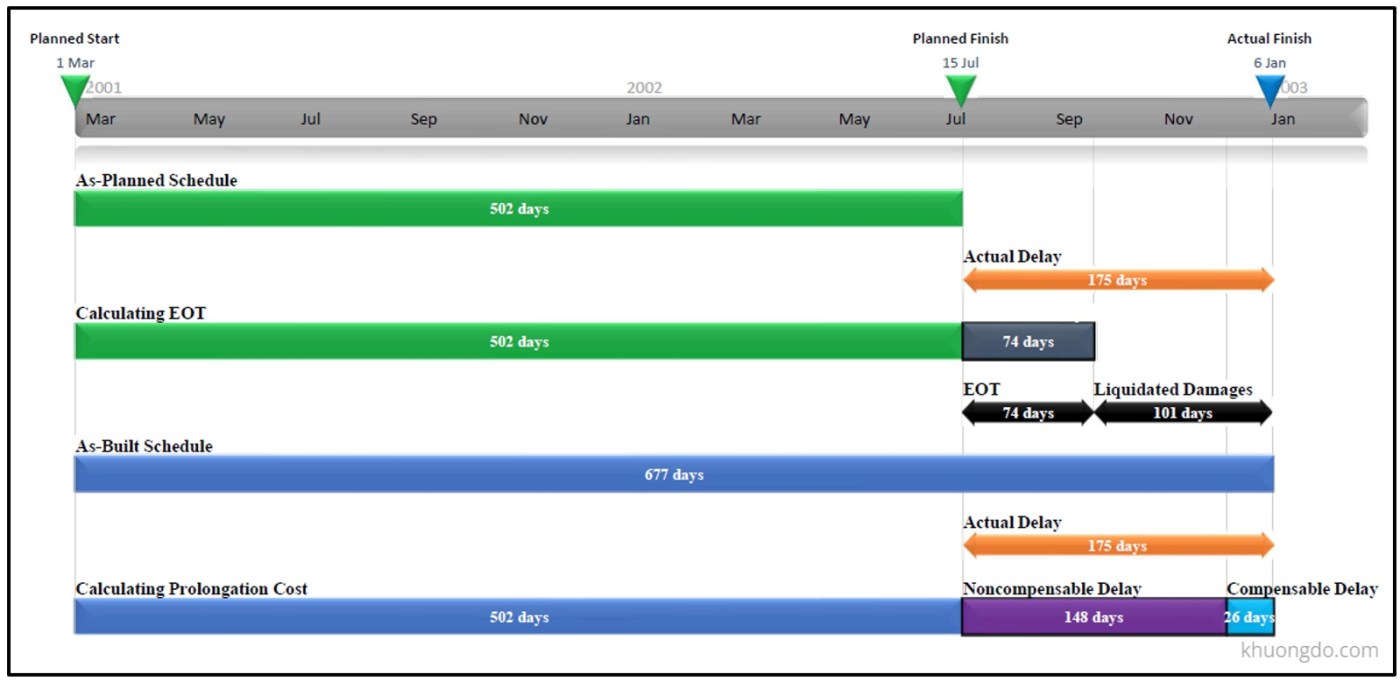
The structure of the delay analysis should be organized in two sections/steps: calculating EOT and calculating compensable delay for prolongation cost.
To calculate correctly the EOT, acceptable delay analysis methods could be Time Impact Analysis, Time Slice Windows Analysis, or As-Planned versus As-Built Windows Analysis.
To calculate correctly the compensable delay for prolongation cost, an acceptable delay analysis method could be Collapsed As-Built.
The results of the steps above are illustrated in the following example.
An example of calculating EOT and compensable delay for prolongation cost
The planned duration of the project was 502 days and the actual duration was 677 days. The actual delay was 175 days.
The first step of the delay analysis was performed and came up with an EOT of 74 days. Therefore, the liquidated damage duration is 101 days.
The second step of the delay analysis was performed and came up with a compensable delay of 26 days.
In conclusion, the Contractor is entitled to an EOT of 74 days and a prolongation cost of 26 days.
Meaning of concurrent delay (from SCL Delay and Disruption Protocol 2nd Edition)
True concurrent delay is the occurrence of two or more delay events at the same time, one an Employer Risk Event, the other a Contractor Risk Event, and the effects of which are felt at the same time. True concurrent delay will be a rare occurrence.
A more common usage of the term ‘concurrent delay’ concerns the situation where two or more delay events arise at different times, but the effects of them are felt at the same time.
In both cases, concurrent delay does not become an issue unless each of an Employer Risk Event and a Contractor Risk Event lead or will lead to Delay to Completion. Hence, for concurrent delay to exist, each of the Employer Risk Event and the Contractor Risk Event must be an effective cause of Delay to Completion (not merely incidental to the Delay to Completion).
As shown in the figure below, two parallel activity paths are each delayed by five workdays during the same window by separate causes, one delay was caused by the owner and the other delay was caused by the contractor, and both affected activities are on the critical path. The two 5-work day delays are concurrent.
Concurrent Delay Illustration: Employer Delay and Contractor Delay occurred at the same time
From a legal perspective, there are two competing views as to whether an Employer Delay is an effective cause of Delay to Completion where it occurs after the commencement of the Contractor Delay to Completion but continues in parallel with the Contractor Delay. This can be illustrated by the following example:
Concurrent Delay Illustration: Employer Delay occurred after Contractor Delay
On one view, the two events are both effective causes of Delay to Completion because they each would havecaused Delay to Completion in the absence of the other.
Advertisements
about:blank
Report this ad
On the other view, the Employer Delay will not result in the works being completed later than would otherwise have been the case because the works were already going to be delayed by a greater period because of the Contractor Delay to Completion. Thus, the only effective cause of the Delay to Completion is the Contractor Risk Event.
The Protocol recommends the latter of these two views (SCL D&D, paragraph 10.10, page 31) (the same opinion is stated in AACE RP 29R-03, page 17, 5th paragraph), i.e. that where an EOT application relating to the situation above is being assessed, the Employer Risk Event should be seen as not causing Delay to Completion (and therefore there is no concurrency). Concurrent delay only arises where the Employer Risk Event is shown to have caused Delay to Completion or, in other words, caused critical delay (i.e. it is on the longest path) to completion.
Allocation of Delay Responsibility When Concurrent Delay Occurs
Types of Delays
Delays can be categorized into two main areas:
Excusable Delays: occur due to events which are outside the control of contractor like storms, strikes, fire, client suggested changes, differing site conditions, change of government policy… etc. When there are excusable delays, the contractor is entitled to a time extension in case the date of the project completion is extended. Excusable delays can be further classified into compensable and noncompensable delays:
Excusable Compensable Delays: are those in which the contractor is entitled to extra payment (compensation) i.e. monetary compensation and time extension as well. But the decision that a delay is compensable or noncompensable is taken as per the contract between owner and contractor. An example of such delay could be that the owner doesn’t allow access to the site even after notice to proceed is given. Such delays which are due to the owner are compensable.
Excusable Noncompensable Delays: are those in which the contractor is entitled to only time extensions, no monetary compensation is provided. Both contractor and owner are not responsible for such delays. An example of such delay could be extreme adverse weather, Act of God.
Non-Excusable Delays: are such that they don’t have any excuse or no excuse can be given for them. They arise due to carelessness or actions and inactions of the contractor. For such delays, no time extensions and monetary compensation are given to the contractor if it has affected the whole duration of the project. In such cases, the owner is liable to get liquidated damages. An example of such delay could be constructing something wrong which is not given in drawings, improper resource allocation, etc.
Basic Principles to Assess Concurrent Delay
The Contracts between the parties:
Contracts may state that neither party is to receive compensation; (No Cost – Have Time)
Some contracts state that when a concurrent delay occurs, not only is no delay compensation available to either party, but the contractor is not entitled to a time extension. (No Cost – No Time)
The most commonly applied principle applied in the international construction industry: The contractor would not be entitled to compensable delay damages and the owner would not be entitled to its actual delay or liquidated damages.
AACE International Recommended Practice No. 29R-03 Forensic Schedule Analysis (Section 4.1. C, page 100-101) states the following with respect to compensability when a concurrent delay occurs:
“Thus, entitlement to compensability, whether it applies to the contractor or the owner, requires that the party seeking compensation shows a lack of concurrency if concurrency is alleged by the other party… Based on this symmetry, contractor entitlement to a time extension does not automatically entitle the contractor to delay compensation. The contractor would first have to show that an owner delay impacted the critical path, and then if the owner defends alleging concurrent delay, the contractor would have to show the absence of concurrent delays caused by a contractor delay or a force majeure delay in order to be entitled to compensation…”
SCL Delay and Disruption Protocol 2nd Edition states the following with respect to compensability when a concurrent delay occurs:
“Where Employer Delay to Completion and Contractor Delay to Completion are concurrent and, as a result of that delay the Contractor incurs additional costs, then the Contractor should only recover compensation if it is able to separate the additional costs caused by the Employer Delay from those caused by the Contractor Delay. If it would have incurred the additional costs in any event as a result of Contractor Delay, the Contractor will not be entitled to recover those additional costs.”
Concurrent Delay Scenarios and Results
The various permutations of concurrent delay are summarised in the table below.
(Source: AACE International Recommended Practice No. 29R-03 Forensic Schedule Analysis, adapted from Figure 12 – Net Effect Matrix – Concurrent Delay)
Equal Delay Duration
There is usually no requirement that concurrent delays must be equal in duration.
Advertisements
about:blank
Report this ad
If the Contractor incurs additional costs that are caused both by Owner Delay and Contractor Delay, then the Contractor should only recover compensation if it is able to separate the additional costs caused by the Owner Delay from those caused by the Contractor Delay.
“Where an Employer Delay to Completion and a Contractor Delay to Completion are concurrent, the Contractor may not recover compensation in respect of the Employer Risk Event unless it can separate the loss and/or expense that flows from the Employer Risk Event from that which flows from the Contractor Risk Event. If it would have incurred the additional costs in any event as a result of concurrent Contractor Delay, the Contractor will not be entitled to recover those additional costs. In most cases, this will mean that the Contractor will be entitled to compensation only for any period by which the Employer Delay exceeds the duration of the Contractor Delay.” (The Society of Construction Law Delay and Disruption Protocol 2nd edition, February 2017, Guidance on Core Principles No.14.3)
This concept is shown in the figure below. In this example:
The owner caused 5 workdays of delay to an activity.
The contractor caused 3 workdays of delay to a different activity.
The contractor receives a 5-work day time extension due to owner-caused delay, but no compensation for the 3-work day of concurrent delay.
Concurrent Delay Vs. Pacing Delay
What is Pacing Delay?
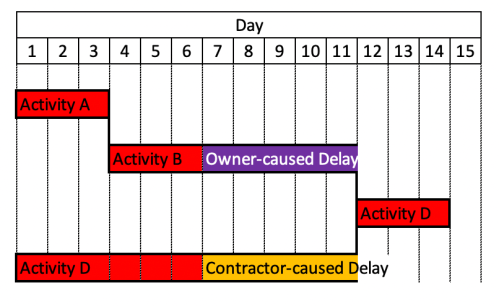
Pacing delay occurs when the delay caused by the owner occurs in one activity, and based on that event a conscious and contemporaneous decision is made by the contractor to pace progress in a second and independent activity. So, the contractor deliberately slowed down its work.
However if the delay in the second activity is caused by factors independent from the first activity, it becomes a concurrent delay.
As shown in the figure below, the owner delayed the pump delivery. So the contractor deliberately slowed down its pump foundation work.
The Purpose of Pacing Delay
A contractor’s decision to “pace” its work was a recurring action, and in many situations, “pacing” was the most appropriate and practical action by a contractor in order to reduce the financial risks caused by an owner-caused delay to the critical path.
Advertisements
about:blank
Report this ad
The reasons behind a contractor’s decision to pace its work could be the following:
Optimising labor and equipment by reducing work in non-critical areas (a contractor is not required to “hurry up and wait”);
Reducing on-site material storage;
Holding the delivery of weather-sensitive equipment.
Pacing Delay Scenarios and Results
The various permutations of pacing delay are summarised in the table below.
Concurrent Delay Vs. Pacing Delay
In its evaluation of potential concurrent delay vs. a pacing delay, the following generally accepted international construction industry guidelines (AACE International Recommended Practice No. 29R-03 Forensic Schedule Analysis, 25 April 2011, Section 4.2.G, p. 113. It does not appear that the SCL has addressed pacing) apply, as follows:
A “main” delay must precede a “pacing” delay;
The contractor needs to demonstrate that it could resume progress at an un-paced rate; and
The contractor needs to provide evidence that a conscious and deliberate decision was made at the time to pace the work as a result of the other delay.
Unfortunately, many contractors failed to diligently inform the owner or adequately document in the contemporaneous project records its decision to “pace” other work. Contractors usually inform the owners after the fact, and so owners are not given the opportunity to understand the implications of the contractor’s action. As a consequence, an atmosphere of distrust between the parties can adversely influence the ability of the parties to reach an amicable resolution regarding a delay claim.
Post 01 _ Test 01Post 01 _ Test 01Post 01 _ Test 01Post 01 _ Test 01Post 01 _ Test 01Post 01 _ Test 01Post 01 _ Test 01Post 01 _ Test 01Post 01 _ Test 01Post 01 _ Test 01Post 01 _ Test 01Post 01 _ Test 01Post 01 _ Test 01Post 01 _ Test 01Post 01 _ Test 01Post 01 _ Test 01Post 01 _ Test 01Post 01 _ Test 01Post 01 _ Test 01Post 01 _ Test 01Post 01 _ Test 01Post 01 _ Test 01Post 01 _ Test 01Post 01 _ Test 01Post 01 _ Test 01Post 01 _ Test 01Post 01 _ Test 01Post 01 _ Test 01Post 01 _ Test 01Post 01 _ Test 01Post 01 _ Test 01Post 01 _ Test 01Post 01 _ Test 01Post 01 _ Test 01Post 01 _ Test 01Post 01 _ Test 01Post 01 _ Test 01Post 01 _ Test 01Post 01 _ Test 01Post 01 _ Test 01Post 01 _ Test 01Post 01 _ Test 01Post 01 _ Test 01Post 01 _ Test 01Post 01 _ Test 01Post 01 _ Test 01Post 01 _ Test 01Post 01 _ Test 01Post 01 _ Test 01Post 01 _ Test 01Post 01 _ Test 01Post 01 _ Test 01Post 01 _ Test 01Post 01 _ Test 01Post 01 _ Test 01Post 01 _ Test 01Post 01 _ Test 01Post 01 _ Test 01Post 01 _ Test 01Post 01 _ Test 01Post 01 _ Test 01Post 01 _ Test 01Post 01 _ Test 01Post 01 _ Test 01Post 01 _ Test 01Post 01 _ Test 01Post 01 _ Test 01Post 01 _ Test 01Post 01 _ Test 01Post 01 _ Test 01Post 01 _ Test 01















 CDQ Blog